
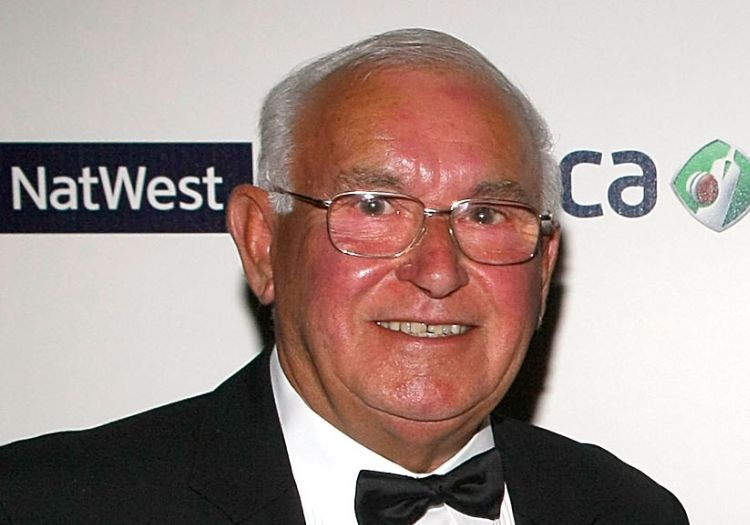
The Cricket Writers’ Club paid tribute to one of its most influential figures, Pat Gibson, at its annual lunch in London on Monday. Gibbo, a former chair of the club, died on Friday after a period of illness.
Here, his close friends and colleagues Colin Bateman and Mark Baldwin continue the tributes.
By Colin Bateman
Around 6pm on a match day, Pat Gibson would disappear to the Press Bar, return with a pint of bitter, sit down in front of his notepad, light a cigarette and stare at a blank piece of paper muttering to himself.
Sometimes he would get to the end of the ciggy without writing a word. He’d light another one and mutter to me: “It’s a two-fag intro today, son.”
Pat would always agonise over that first sentence. I never knew why because he wrote such stylish, well-constructed and original copy. He was a master craftsman, brought up on regional newspapers. Succinct, clean copy always to length.
He was also my mentor at the Daily Express after I became his ‘No. 2’ in 1984. Towards the end of that summer, he asked me if I fancied a trip to India as he wanted a winter off of touring – and the subcontinent wasn’t his favourite destination.
“Stick close to Smudger, son, and you won’t go far wrong,” was his advice. ‘Smudger’ was Peter Smith, his great friend and rival from the Daily Mail. While the pair of them were pretty inseparable at Press conferences and in the bar – as their intros often revealed – Gibbo was his own man and distinctly cynical about the cricket establishment.
“He was a generous colleague with a lovely dry sense of humour that belied the gruff exterior he presented to noisy interlopers in Press Boxes and supercilious players at conferences. He knew more about the game than most of them would ever understand”
Colin bateman on pat gibson
In 1987 he ‘moved upstairs’ to the Sunday Express, recommending me to be his successor on the Daily title, for which I was forever grateful. A change of hierarchy at the Sunday paper a few years later decided they wanted ‘named’ writers and so Pat was moved out and David Gower installed as the cricket correspondent, a decision which left Gibbo very bitter.
He need not have worried. He was too good to be left out of work for long. In 1994, The Times employed him and Gibbo flourished. Less constrained by the demands of a tabloid, he wrote with great elan for The Thunderer on the county circuit and covering tours, often between two ‘neutral’ countries away from the mayhem of an England series. He particularly enjoyed the Caribbean, where he was great friends with Tony Becca (Jamaica) and Tony Cozier (Barbados).
If not busy with cricket, Gibbo – a staunch Grimsby fan and friend of former England manager Graham Taylor – would cover football for the Times with a withering eye on the modern trends of the game.
Many of us were looking forward to seeing Pat again at our annual lunch on Monday. Instead we raised a glass to a great colleague and a lovely man.
By Mark Baldwin
I had already worked alongside Pat Gibson for several years, at home and abroad, by then knowing him reasonably well as a much-respected but determinedly self-contained colleague, when he turned to me at an otherwise deserted press box at Grace Road – others having filed their copy and departed either for home or the fleshpots of Leicester – and said: “Fancy a pint, son?”
That was 35 years or so ago now, but I still remember it well and prize the memory because it meant Gibbo thought I was all right and because by no means everyone could pass that particular test.
In the gossipy world of sports journalism Gibbo was one of the rarer beasts. He would never betray a confidence and – providing, of course, you were accepted as someone trustworthy enough in return – was a most loyal and perceptive fellow traveller, blessed with a wonderfully dry sense of humour. The story was always his gimlet-eyed priority, and he broke many exclusive ones in a half-century at the sharp end, but he also valued friendships made along the way, including with those players and administrators he liked and who came to trust him too.
Gibbo could certainly be a curmudgeonly presence, however, and he might even have come across as downright grumpy to those who never got that silent, treasured nod of approval from him. He didn’t suffer fools gladly, but he was unquestionably a great journalist and never forgot the responsibility that came with the reporter’s job, particularly in the care required to present both sides of a story, or issue, in a scrupulously fair manner.
Neither did he think it the reporter’s role to insert his own opinion or prejudice into a piece that would often seem as if it were being chiselled out of stone rather than merely being tapped into a typewriter or laptop, such was the effort he put into telling the story as concisely and accurately as he could.
That classically ‘neutral’ reporting style, moreover, was a journalistic strength, and indeed an ability, that might be beneficially remembered by a sadly increasing number of writers and broadcasters.
“Those journalists fortunate enough to count him as a friend have benefitted much from Gibbo’s wisdom, advice and intimate knowledge of our profession. Yet he also cared deeply for the game of cricket, and for the way it is played and administered, as well as the constant need to fight the corner of those charged with reporting it”
MARK BALDWIN ON PAT GIBSON
That is why he accepted the CWC committee’s invitation to chair our club for six years – a record length of tenure – and, when I succeeded him in 2014 having had many prior discussions with him on those very subjects, it was also one of the major reasons why I was able to have a clear view of the CWC’s continued future direction of travel.
His legacy, as one of the foremost cricket writers of his time, is itself substantial enough when highlighted from the depth and breadth of an enviable 60-year body of wider journalistic work, but in terms of the Cricket Writers’ Club (and notwithstanding its main function as a social club) Pat Gibson fully deserves a place up alongside the likes of Jim Swanton, John Woodcock, Robin Marlar, Derek Hodgson, Christopher Martin-Jenkins and, not least, Wendy Wimbush as the officers who have done most – and for longest – to promote media influence on the game’s governance and profile.
By Paul Weaver
To encounter Pat Gibson in a press box was to experience the conflicting emotions of apprehension and exultation. The anxiety came with the realisation that here was a colleague who knew more people than you did, who was better informed, who might hurt you, professionally, with his superior weaponry.
The exhilaration came with the knowledge that if you could just penetrate the outer grouch and wheedle your way into his cosy coterie (he was a quietly gregarious man who preferred the intimacy of small numbers) you were in for a very good time. There would be jokes and anecdotes and his face would crease with laughter as the mischievous twinkle in his eye, magnified by his thick glasses, pierced through the fug of cigarette smoke that curled round him like a grey-blue shawl.
The important thing about Gibbo was that he loved cricket more than cricket writing. Players and administrators knew that, which was why they traded their confidences for his wise counsel. His first loyalty was to the game itself, not to the newspapers which employed him.
If that suggests he short-changed his sports editors nothing could be further from the truth. He was an outstanding correspondent for the Daily Express and, later, the Sunday Express, working alongside his great pal, the Daily Mail’s Peter Smith. That’s because his many contacts told him stuff he could use as well as the bits he couldn’t.
At the end of his career, writing for The Times, he was still a formidable operator because his essential integrity continued to layer, like a coastal shelf. He was distinctly old school, as protective of his sources as he was of his foaming pint. And, with jacket and tie, he was invariably smart, ready for the frequent invitations to the committee room – especially if he was at Trent Bridge or The Oval.
He was the least pretentious of writers but his clean, precision-tooled copy resonated with the authority of the well informed. And if his reports often suggested that he knew more than he was letting on … that’s because he did.
At first, I thought he was permanently miserable, attributing his sullenness to the natural affliction of any Grimsby Town supporter. Then he started to trust me and I got to know one of the best of colleagues. He took me under his wing on my first England tour, to the West Indies in 1981. On the very first evening we were in a bar in Antigua when a famous England cricketer was engaged in a physical confrontation with the bar manager. “What should we do, Gibbo?” I asked, checking my watch for English deadlines.
“Nothing, son,” he replied. “It’s a long tour.”